





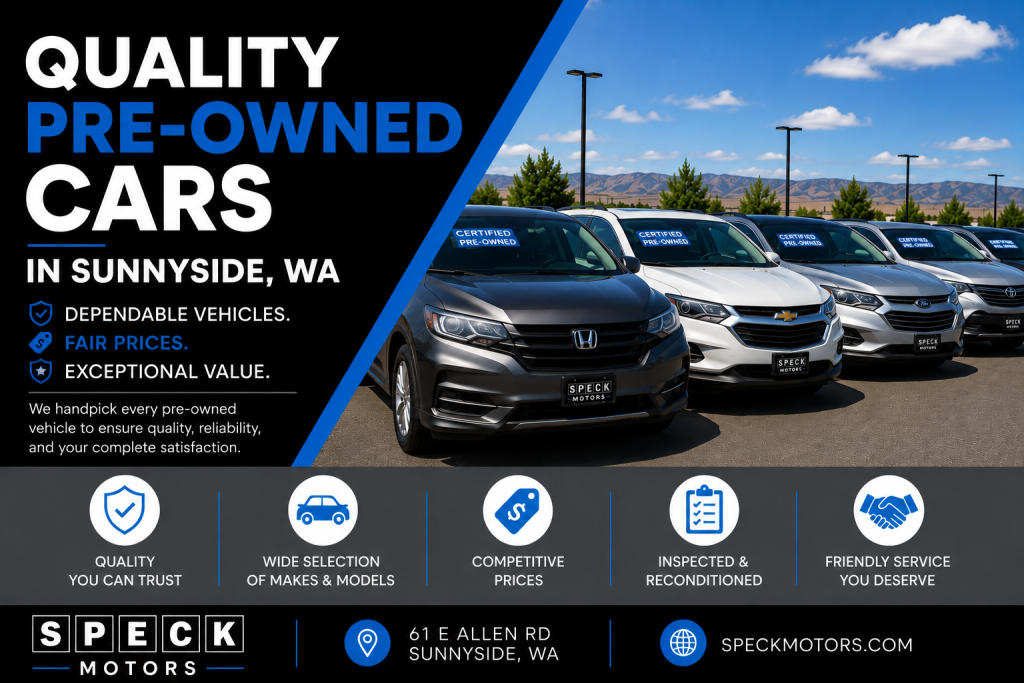
Not all used cars are created equal — and at Speck Motors, we take that seriously. As a quality used car dealership in Sunnyside, WA, we go beyond just stocking a large selection. We make sure every used car meets a quality standard and is backed with a full CARFAX Vehicle History Report.
What Makes a Quality Pre-Owned Vehicle?
When we talk about “quality used cars for sale”, we mean vehicles we’d feel comfortable putting our own families in. Here’s what that looks like in practice:
Clean Vehicle History
No hidden surprises. We prioritize vehicles with clean titles, documented service histories, and transparent ownership records.
Inspection Before Sale
Used cars at Speck Motors go through an inspection before hitting our lot. This prevents you from inheriting someone else’s deferred maintenance.
Fair, Transparent Pricing
We price our pre-owned inventory competitively and honestly. No inflated stickers, no surprise fees — just straightforward pricing you can evaluate with confidence.
CARFAX on Every Vehicle — No Exceptions
Buying a used car can feel like a leap of faith. That’s why we provide a free CARFAX Vehicle History Report on every pre-owned vehicle we sell — no asking, no extra cost, no fine print. It’s simply part of how we do business.
Every CARFAX report we provide includes: accident and damage history, number of previous owners, service and maintenance records, title history (including salvage or flood titles), odometer readings over time, and whether the vehicle was used as a rental or fleet vehicle.
This matters because two vehicles with the same year, make, and model can tell different stories. A CARFAX report puts that story in your hands — and at our quality used car dealership, we believe every buyer deserves that transparency upfront.
Why Buy a Quality Used Car in Sunnyside?
- Significant Savings Over New: A quality pre-owned vehicle gives you reliable, well-equipped transportation at a fraction of the new car price. That means someone else absorbed the first-year depreciation hit.
- Lower Insurance & Registration Costs: Used vehicles typically cost less to insure and register than new ones, adding to your overall savings.
- More Vehicle for Your Budget: The same budget that gets you a base trim new vehicle often gets you a higher trim, lower mileage pre-owned option.
- Flexible Financing Available: Our finance team works with a wide range of lenders to find a payment that works for your budget and credit situation — first-time buyers always welcome.
Ready to find your quality used car in Sunnyside, Washington?
Stop by Speck Motors in Sunnyside and our team will walk you through every used car for sale on the lot. No pressure, just good vehicles and honest answers.
The information provided is for general informational purposes only and does not constitute legal, financial, or professional advice. While we strive to provide accurate and up-to-date information, we make no guarantees regarding the completeness, accuracy, or reliability of the information presented. Any action you take based on the context of this blog is strictly at your own risk. Always consult a qualified professional or specialist for advice specific to your situation. We are not responsible for any losses or damages arising from the use of this blog or its content.
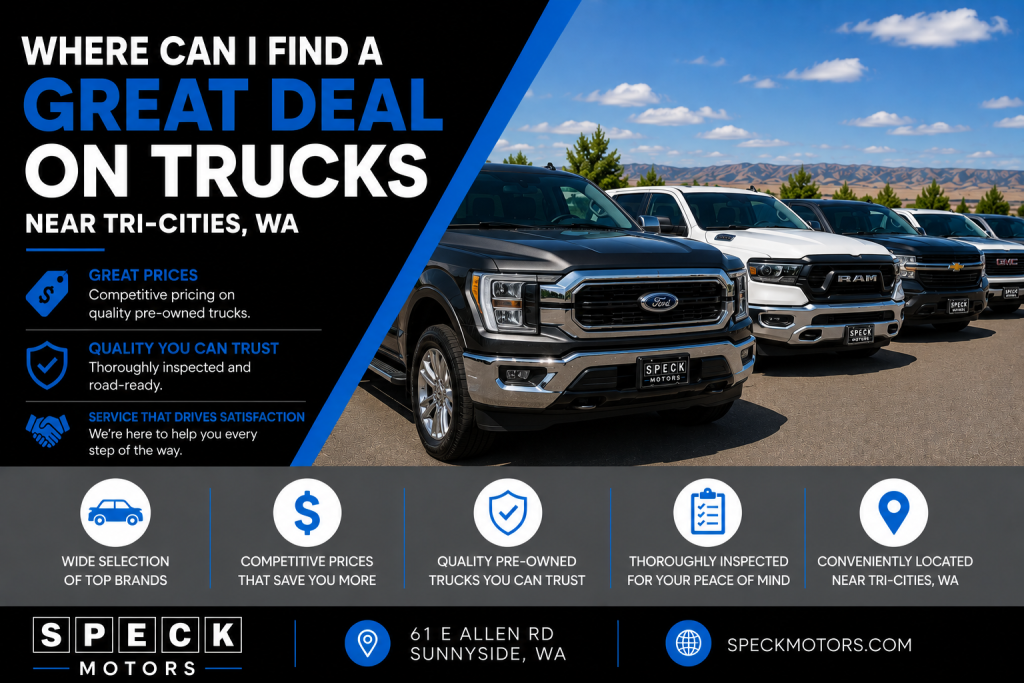
If you’re searching for the best truck deals near the Tri-Cities, the answer might be closer than you think. Speck Motors in Sunnyside is just a short drive from Kennewick, Richland, and Pasco. We carry new and pre-owned trucks across all the most popular brands. Need a half-ton for daily driving? A heavy-duty workhorse for the farm? A budget-friendly used truck? We have it. Here’s why Tri-Cities drivers keep making the drive to Sunnyside.
New Truck Deals — Latest Models, Best Incentives
Buying new means the latest technology, full factory warranty, and access to manufacturer incentives. At Speck, we carry new trucks from the most trusted brands. We work hard to find you the best deal available. Low-APR financing, cash rebates, and lease specials are updated every month.
Chevrolet Half-Ton Truck
The Silverado 1500 is the most versatile and popular trucks on the road. Great for daily driving and weekend hauling alike.
Chevrolet Heavy-Duty Trucks
The Silverado HD handles the heaviest farm, ranch, and job site loads.
Chevrolet Mid-Size Truck
The Chevrolet Colorado truck offers capability in a more nimble, fuel-efficient package — perfect for Yakima Valley drivers who want a truck without the full-size footprint.
Chevrolet Work Truck Trims
Looking to keep costs down? Work Truck (WT) trims across our lineup strip things back to pure capability — maximum towing, 4WD, and a durable interior at a lower price point.
Pre-Owned Truck Deals — More Value for Your Budget
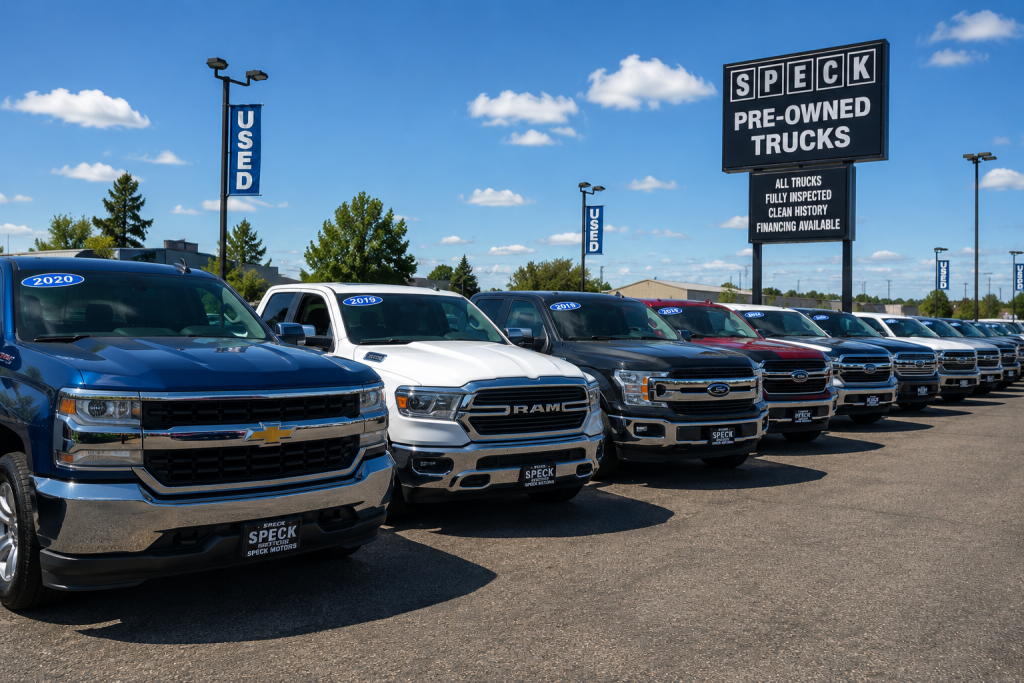
A quality pre-owned truck is one of the best values you can find at a dealership. With over 400 pre-owned vehicles on our lot at any given time, we regularly carry a strong selection of used trucks across multiple makes, model years, and configurations — with CARFAX Vehicle History Reports provided on every vehicle. A used Silverado, F-150, or Ram with 30,000–60,000 miles can save you thousands off the new-car price while still delivering years of reliable service ahead.
Why Make the Drive from Tri-Cities to Speck in Sunnyside?
- One of the Largest Truck Selections in the Area: With new and pre-owned trucks across multiple brands and body styles, we’re one of the most well-stocked truck dealers near the Tri-Cities. More options means a better chance of finding exactly the right truck.
- Competitive Pricing & Real Discounts: We don’t add markups. We stack manufacturer incentives with dealer discounts to bring you the most competitive price available — on new and pre-owned trucks alike.
- Lower Sales Tax in Sunnyside: Sunnyside’s sales tax rate of 8.2% is lower than Kennewick (8.8%), Richland (8.8%), and Pasco (8.9%). On a $45,000 truck, that difference can save you $270 or more — before the deal is even negotiated.
- Flexible Financing for Every Buyer: Our finance team works with a wide range of lenders to find the best rate for your situation. Good credit, first-time buyer, or somewhere in between — we’ll find a payment that works.
- Locally Owned & Community-Focused: Speck Motors is a local business. We’re invested in this community and treat every customer like a neighbor, because you are one.
Ready to find your next truck in Sunnyside, Washington?
Browse our current new and pre-owned truck inventory near the Tri-Cities online, or make the short drive to Sunnyside and see what we have on the lot. Our team knows trucks, knows the Yakima Valley, and is ready to help you find the right one at the right price.
The information provided is for general informational purposes only and does not constitute legal, financial, or professional advice. While we strive to provide accurate and up-to-date information, we make no guarantees regarding the completeness, accuracy, or reliability of the information presented. Any action you take based on the context of this blog is strictly at your own risk. Always consult a qualified professional or specialist for advice specific to your situation. We are not responsible for any losses or damages arising from the use of this blog or its content.
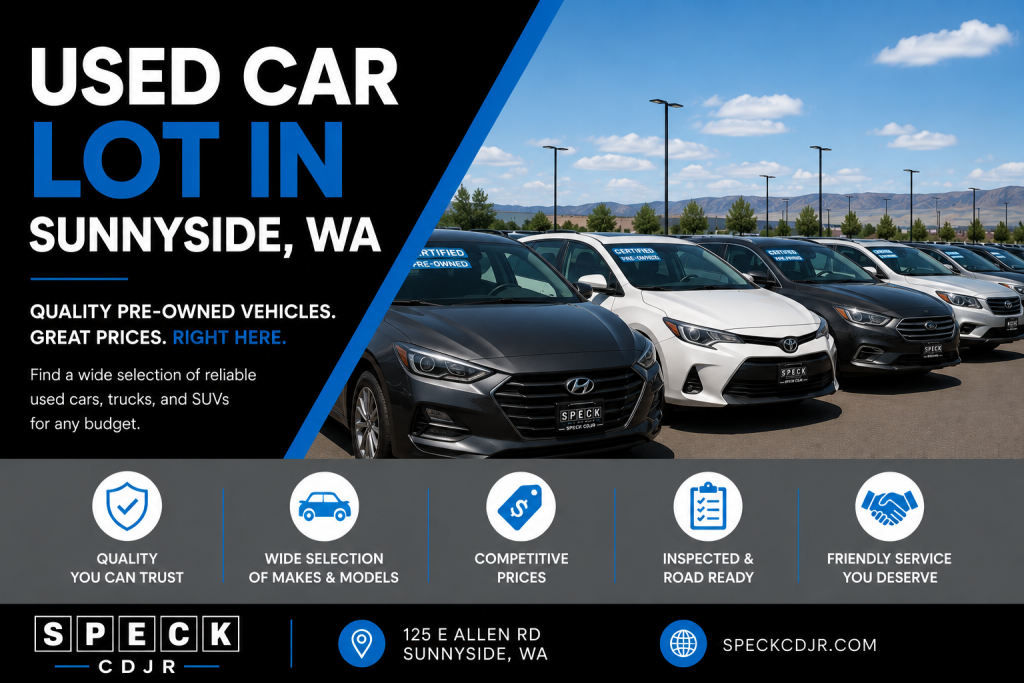
If you’ve been searching for used car deals in the Sunnyside area, look no further. Speck Motors carries over 400 pre-owned vehicles — making us the go-to used car destination in the Yakima Valley. From budget-friendly commuter cars to low-mileage trucks and SUVs, we carry something for every driver and every budget. Whatever you drive or whatever you need, we have fresh options arriving all the time.
- Hundreds of Pre-Owned Vehicles
- All Makes and Models
- Every Budget Welcome
Popular Used Vehicles in Sunnyside, Washington
We regularly carry the most in-demand models in the Yakima Valley and Tri-Cities area. Here are three fan favorites you’ll frequently find on our lot:
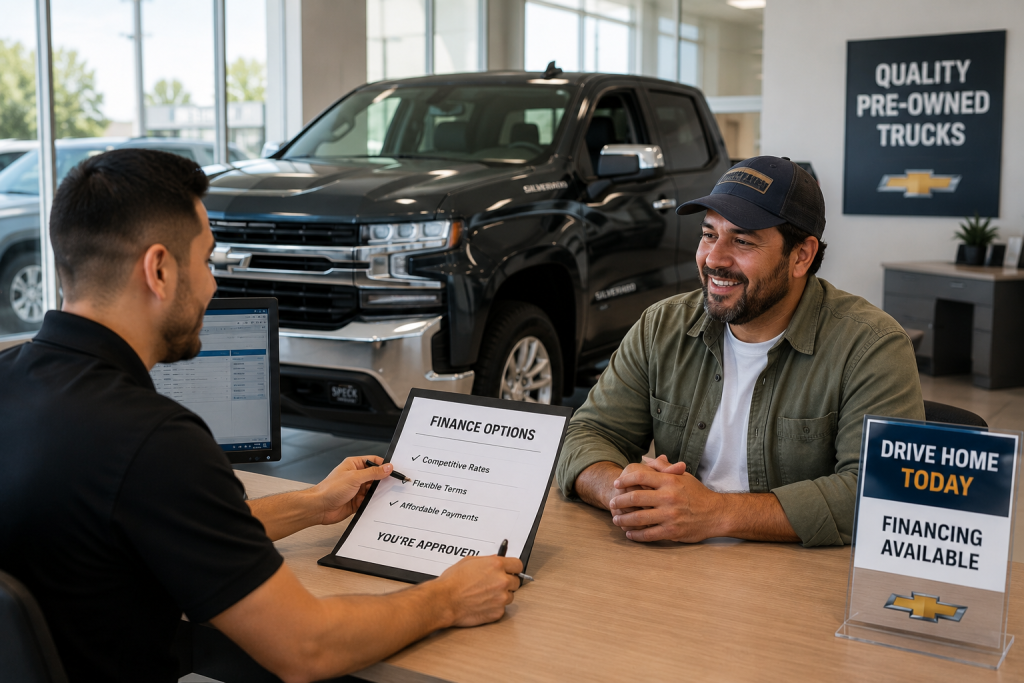
Most Popular Work Truck
Chevrolet Silverado 1500
The Chevy Silverado 1500 is one of the most sought-after used trucks in Eastern Washington — and it’s easy to see why. Reliable and capable, a used Silverado covers everything from daily commuting to weekend hauling. We stock multiple Silverado examples across different model years, trim levels, and price points. Need a stripped-down work truck or a well-equipped crew cab? We’ve got both.
America’s Best-Selling Truck
Ford F-150
The Ford F-150 is the best-selling vehicle in America for a reason — and used examples are always in high demand at our Sunnyside used car lot. Versatile, well-built, and available with a range of powerful engine options including the EcoBoost V6 and 5.0L V8, a used F-150 holds up exceptionally well over time and delivers real value for Yakima Valley drivers who need a truck for work, recreation, or both. We typically carry a strong selection of model years, cab styles, and trim levels.
Top-Rated Compact SUV
Toyota RAV4
The RAV4 is consistently one of the best-reviewed compact SUVs on the market — and its reputation for reliability makes it one of the most desirable used vehicles available. Fuel-efficient, roomy, and available with AWD for Eastern Washington winters, a used Toyota RAV4 is a smart buy for commuters, families, and anyone who wants a dependable vehicle that holds its value. We work hard to keep competitively priced RAV4 examples on our lot across multiple model years.
Why Shop at Our Sunnyside Used Car Lot?
- Over 400 Vehicles to Choose From: With one of the largest pre-owned selections in the Yakima Valley, you’re far more likely to find exactly what you’re looking for — the right make, model, year, color, and price point — all in one place.
- Something for Every Budget: Our inventory spans a wide range of price points, from affordable everyday vehicles under $15,000 to low-mileage near-new options for buyers who want more. Whatever your budget, we’ll help you find the right fit.
- Flexible Financing Options: Our finance team works with a wide network of lenders to help buyers at every credit level get into a payment that works. First-time buyers and credit-challenged buyers are always welcome.
- Inventory That Rotates Regularly: New vehicles arrive all the time. If you don’t see exactly what you’re looking for today, check back soon — or let our team know what you need and we’ll reach out when the right vehicle comes in.
One of the best used car deals in Sunnyside starts here.
Browse our full inventory of 400+ pre-owned vehicles online, or stop by our lot in Sunnyside — we’re one of the most established used car dealers in Sunnyside, WA, and our team is ready to help you find the right vehicle at the right price. No pressure, no runaround — just a great selection and a straightforward buying experience.
The information provided is for general informational purposes only and does not constitute legal, financial, or professional advice. While we strive to provide accurate and up-to-date information, we make no guarantees regarding the completeness, accuracy, or reliability of the information presented. Any action you take based on the context of this blog is strictly at your own risk. Always consult a qualified professional or specialist for advice specific to your situation. We are not responsible for any losses or damages arising from the use of this blog or its content.
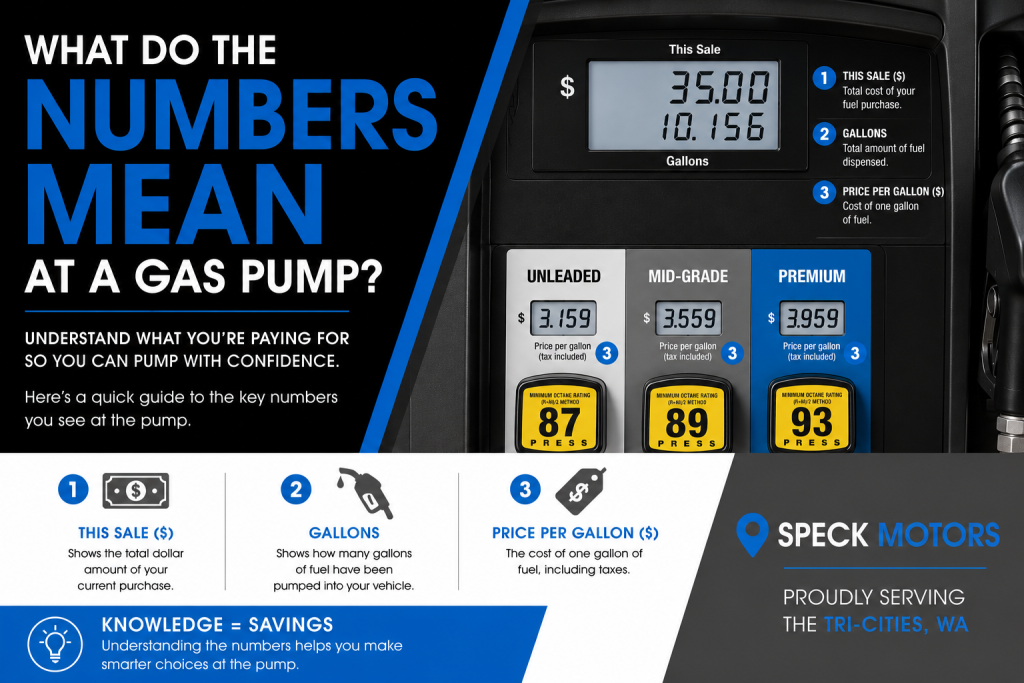
You pull up to the gas pump and stare at three buttons — 87, 89, 91. Most drivers just hit 87 and go. But have you ever wondered what those numbers actually mean? Here’s your complete guide to gas pump numbers explained — including octane ratings, fuel grades in Washington State, and what octane actually does for your engine.
What Are the Numbers at the Gas Pump?
The numbers you see — typically 87, 89, and 91 — are gas octane ratings. They represent the fuel’s ability to resist “knocking” or “pinging” during combustion. The higher the number, the more resistant the fuel is to premature ignition inside your engine.
What Is Octane — And Why Does It Matter?
What is octane? It’s a measure of a fuel’s stability under pressure. Inside your engine, the air-fuel mixture is compressed before being ignited by the spark plug. If the fuel ignites too early, it causes a knocking sound and can damage your engine over time. Higher octane fuel resists that premature ignition better — which matters most in high-performance or turbocharged engines.
Fuel Grades in Washington State
Here’s what each gas station fuel grade means:
Regular — 87 Octane
The most common and affordable grade. Recommended for the vast majority of vehicles — including most Chevrolet, GMC, Jeep, Ram, Hyundai, Nissan, and Buick models. If your owner’s manual says “regular unleaded,” this is your fuel. Using a higher grade won’t improve performance or fuel economy — you’ll just spend more money for no benefit.
Mid-Grade — 89 Octane
Sits between regular and premium. Some older vehicles may recommend mid-grade — always check your owner’s manual. For most modern vehicles, mid-grade offers no meaningful advantage over regular.
Premium — 91 or 92 Octane
Recommended or required for high-performance, turbocharged, or supercharged engines. There’s an important distinction:
- “Premium Recommended” — Your vehicle runs fine on regular but may perform slightly better on premium.
- “Premium Required” — Your engine is designed for high-octane fuel. Using regular can cause knocking and long-term engine damage.
Always check your owner’s manual or fuel door sticker to know which grade your vehicle requires.
E85 — Flex Fuel
Available at some Washington State stations. E85 is only compatible with Flex Fuel vehicles — using it in a non-flex fuel vehicle can cause serious engine damage. Look for the yellow flex fuel cap to know if your vehicle is compatible.
Does Higher Octane Mean Better Fuel?
No — and this is one of the most common misconceptions about fuel octane ratings. Higher octane fuel is not inherently better or cleaner. It simply resists premature ignition better. Putting 91 in a vehicle designed for 87 will not make it faster or more fuel-efficient. The right fuel is the one your manufacturer recommends — nothing more, nothing less.
Quick Reference — Gas Pump Numbers Explained
- 87 — Regular — For most everyday vehicles
- 89 — Mid-Grade — For select engines that specifically recommend it
- 91/92 — Premium — For high-performance or turbocharged engines
- E85 — Flex Fuel — Only for Flex Fuel vehicles
Not Sure What Fuel Your Vehicle Takes?
Check your owner’s manual, the sticker inside your fuel door, or ask our service team at your next visit. Our certified technicians at Speck Motors are always happy to answer questions about your vehicle during your next service appointment. Stop by or schedule online today.
Summer in Eastern Washington is beautiful — but it’s also brutally hot. As temperatures in the Yakima Valley and Tri-Cities regularly climb into the 90s and 100s, we want to take a moment to share something that goes beyond selling cars. This summer, the most important reminder we can give is simple: never leave pets in a hot car. It’s a message we care about deeply as a community business — it can be fatal, and it can happen much faster than most people realize.
How Hot Does a Car Actually Get?
This is where many well-meaning pet owners underestimate the danger. A parked car is not just warm — it becomes an oven, and quickly.
On an 85°F day, the inside of a parked car can reach 102°F in just 10 minutes — and over 120°F within 30 minutes. Cracking a window makes almost no difference. On a 100°F Eastern Washington summer day, interior temps can climb past 140°F. Dogs can only withstand temperatures above 107°F for a very short time before organ failure begins.
Signs of Heatstroke in Animals
If you find an animal that has been left in a hot car, or notice your own pet showing any of the following signs, it’s a medical emergency:
Heavy, rapid panting
Dogs cool themselves by panting. Excessive, frantic panting is one of the first signs of overheating.
Glazed or unfocused eyes
Disorientation, glassy eyes, or an inability to focus are signs of heat distress progressing to heatstroke.
Drooling or vomiting
Excessive drooling, foaming at the mouth, or vomiting are serious warning signs that need immediate attention.
Weakness or collapse
Stumbling, muscle weakness, or collapse means the animal is in critical condition. Call a vet immediately.
What to Do If You See an Animal in a Hot Car
- 1.Note the vehicle’s make, model, and license plate and immediately notify nearby businesses or have the owner paged if you’re in a parking lot.
- 2.Call 911 or local animal control. In Washington state, law enforcement can legally break a window to rescue an animal in distress from a hot vehicle.
- 3.Stay with the animal and continue monitoring its condition while help is on the way.
- 4.If the animal is rescued, move it to a cool, shaded area, offer small sips of cool (not ice cold) water, and get to a veterinarian as quickly as possible.
Tips for Traveling With Pets This Summer
We love that so many Yakima Valley and Tri-Cities families bring their pets along on road trips and errands. Here are a few simple habits that keep your animals safe all summer long:
Never Leave Pets in a Hot Car This Summer — Plan Ahead
If you’re running errands, bring someone along who can stay in the car with the AC running, or leave your pet at home. No errand is worth the risk. Use your vehicle’s remote start. Many newer vehicles — including models across our lineup — offer remote start so you can cool your car down before getting in. That same feature can keep your AC running while you quickly run in somewhere, though we still recommend not leaving pets unattended. Bring water. Always carry fresh water for your pet on summer trips, and offer it at every stop.
From all of us at Speck Motors — we care about this community, your families, and your pets. If you ever see an animal in distress in a hot vehicle in Prosser, Sunnyside, or anywhere in the Yakima Valley, please don’t hesitate to act. A quick call to 911 could save a life. Stay safe this summer, and thank you for being part of the Speck family.
If you’re in the market for a full-size family SUV that checks every box — three rows of seating, serious towing capability, and long-term reliability — the Chevrolet Tahoe is hard to beat. At C Speck Motors in Sunnyside, we consistently carry used Chevrolet Tahoe’s in our inventory, making us one of the best places in Yakima County to find a great deal on one. Whether you’re looking for a recent model year or a well-priced older example, we keep a rotating selection ready for you to explore.
Why the Chevrolet Tahoe?
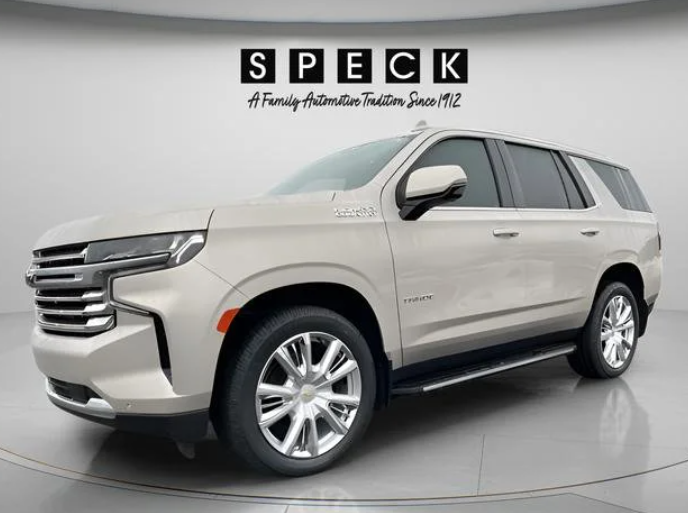
The Tahoe has been America’s go-to full-size SUV for good reason. It combines a body-on-frame build for serious durability and towing with a genuinely comfortable, spacious interior that works equally well for family road trips and daily Yakima Valley commutes. Here are some of the highlights that keep buyers coming back to the Tahoe year after year:
Three-Row Seating: Seats up to 9 passengers across three rows, with a grown-up-friendly third row that’s actually usable on long drives.
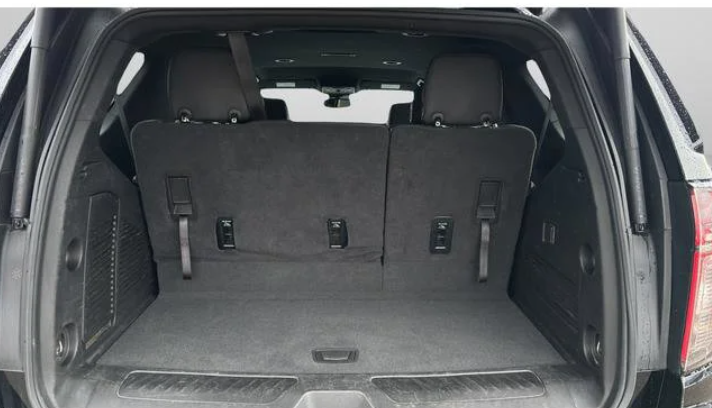
Massive Cargo Space: 25.5 cu ft behind the third row, 72.6 cu ft with third row folded, and up to 122.9 cu ft with both rows down.
Towing Capability: Up to 8,400 lbs when equipped with the Max Trailering Package — enough for a boat, camper, or utility trailer.
Engine Options: Available 5.3L V8, 6.2L V8, and 3.0L Duramax turbo-diesel for improved fuel economy on long hauls.
Standard Safety Tech: Automatic emergency braking, lane keep assist, front pedestrian braking, and a following distance indicator come standard.
Modern Infotainment: 10.2″ touchscreen with wireless Apple CarPlay, Android Auto, 4G LTE Wi-Fi hotspot, and available Super Cruise on higher trims.
Shopping in Yakima County pays off.
Sunnyside’s sales tax rate of 8.2% is lower than Kennewick (8.8%), Richland (8.8%), and Pasco (8.9%). On a $50,000 used Tahoe, that difference can add up to $350 or more in savings compared to buying in the Tri-Cities — before we even talk about the deal itself.
We keep used Chevrolet Tahoe’s in stock regularly, and our inventory turns over quickly. Browse our current used SUV selection online or stop by the lot in Sunnyside — our team will walk you through every option and help you find the right Tahoe at the best price in Yakima County.
The information provided is for general informational purposes only and does not constitute legal, financial, or professional advice. While we strive to provide accurate and up-to-date information, we make no guarantees regarding the completeness, accuracy, or reliability of the information presented. Any action you take based on the context of this blog is strictly at your own risk. Always consult a qualified professional or specialist for advice specific to your situation. We are not responsible for any losses or damages arising from the use of this blog or its content.
For business owners in the Sunnyside and Yakima Valley area — agriculture, construction, landscaping, and beyond — the right work truck isn’t a luxury. It’s an investment. Chevrolet trucks have built a strong reputation for reliability and capability. With a wide range of configurations, they’re a natural fit for business use. Here’s a breakdown of the new Silverado lineup — payload and towing specs that matter most when you’re putting a truck to work every day.
Chevrolet Silverado Payload & Towing Comparison
When it comes to Chevrolet Silverado tow and payload numbers, the right model depends on the size of your jobs. Here’s how the three Silverado models stack up:
| Model | Max Towing | Max Payload | Best For |
|---|---|---|---|
| Silverado 1500 | 13,300 lbs | 2,260 lbs | Light-duty business use, daily driving, smaller trailers |
| Silverado 2500 HD | 22,420 lbs (diesel) | 3,689 lbs (gas) | Contractors, equipment haulers, horse & livestock trailers |
| Silverado 3500 HD | 36,000 lbs (diesel) | 7,234 lbs (gas, dually) | Maximum commercial hauling, gooseneck & fifth-wheel towing |
*All figures are for 2025 models when properly equipped. Final ratings vary by cab, bed, engine, and configuration. Verify your truck’s specific ratings on the door jamb sticker.
Silverado 1500 — The Versatile Business Daily Driver
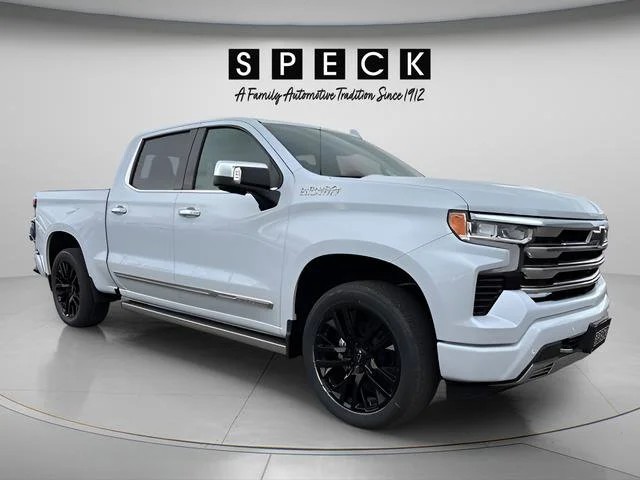
Need a work truck that doubles as a daily driver? The Silverado 1500 hits the sweet spot. It comes in four engine options, including a fuel-efficient 3.0L Duramax diesel. Cab and bed configurations are available to suit different business needs. The Work Truck (WT) trim keeps things practical and affordable. Prefer more comfort? Higher trims like the LT and LTZ add creature comforts for owners who spend long hours behind the wheel.
Best for: Small business owners, landscapers, real estate agents, and tradespeople who need everyday capability without the size of a heavy-duty truck.
Engine options include the 2.7L TurboMax I4 (best payload), 5.3L V8 (popular all-rounder), 6.2L V8 (max towing), and 3.0L Duramax diesel (best fuel economy at ~23 MPG city).
Silverado 2500 HD — The Heavy-Duty Workhorse
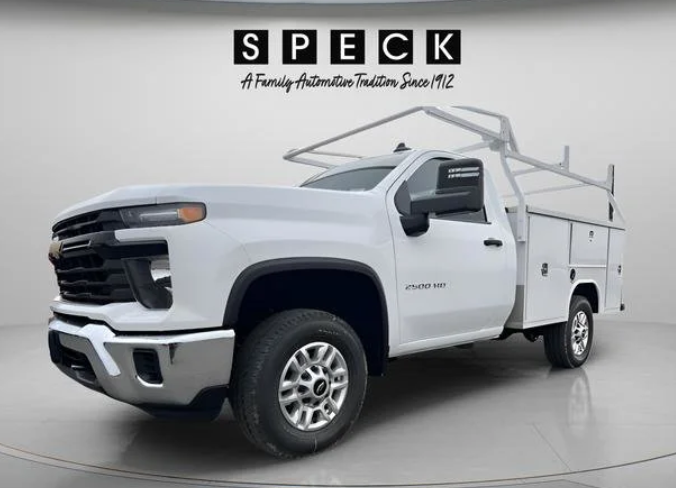
When your business regularly involves moving heavy equipment, pulling large trailers, or loading the bed with materials, the Silverado 2500 HD is where the Chevrolet Silverado tow and payload numbers get serious. The available 6.6L Duramax Turbo-Diesel delivers 470 horsepower and a massive 975 lb-ft of torque — enough to pull up to 22,420 lbs. For Yakima Valley business owners hauling farm equipment, large utility trailers, or heavy materials between job sites, this is the truck that earns its keep day in and day out.
Best for: Contractors, farmers, equipment haulers, and any business owner whose loads regularly push or exceed the 1500’s limits.
Engine options: 6.6L V8 Gas (401 HP, max payload focus) or 6.6L Duramax Turbo-Diesel (470 HP, max towing focus). Available in Regular Cab, Double Cab, and Crew Cab with 6’9″ or 8′ bed.
Silverado 3500 HD — Maximum Commercial Capability
The Silverado 3500 HD is the top of the Chevrolet trucks lineup and built for business owners who need every pound of capability available. With up to 36,000 lbs of towing (diesel, fifth-wheel/gooseneck) and up to 7,234 lbs of payload in dually configuration, this truck is the right tool for commercial hauling, large-scale agriculture, and heavy construction. The available dually (DRW) rear axle setup adds stability when towing maximum loads and significantly boosts payload capacity.
Best for: Commercial contractors, large-scale farmers, businesses regularly towing gooseneck or fifth-wheel trailers, and anyone who needs the absolute most from a pickup.
Work Truck trims available across the lineup. All three Silverado models offer a dedicated Work Truck (WT) trim — a no-frills, job-ready configuration that gives you maximum capability at a lower price point. It’s a smart choice for business owners who want to keep costs down without sacrificing what the truck can do.
Whether you’re looking for a light-duty daily driver or a full commercial hauler, our team at C Speck Motors in Sunnyside is here to help you find the right Chevrolet work truck for your business. Stop by or browse our current inventory online — and let’s put the right truck to work for you.
The information provided is for general informational purposes only and does not constitute legal, financial, or professional advice. While we strive to provide accurate and up-to-date information, we make no guarantees regarding the completeness, accuracy, or reliability of the information presented. Any action you take based on the context of this blog is strictly at your own risk. Always consult a qualified professional or specialist for advice specific to your situation. We are not responsible for any losses or damages arising from the use of this blog or its content.
If you’ve been searching for a used Chevy truck near Sunnyside, WA, you’re in the right place. At C Speck Motors, we consistently carry a strong selection of used Chevrolet pickups — from the nimble Colorado all the way up to the heavy-duty Silverado 2500. Whether you’re hauling gear across the Yakima Valley, tackling a weekend project, or just need a dependable daily driver, there’s a used Chevy truck on our lot that fits the job. And as you’ll see below, buying in Sunnyside comes with a tax advantage that Tri-Cities buyers shouldn’t overlook.
Used Chevy Trucks We Carry
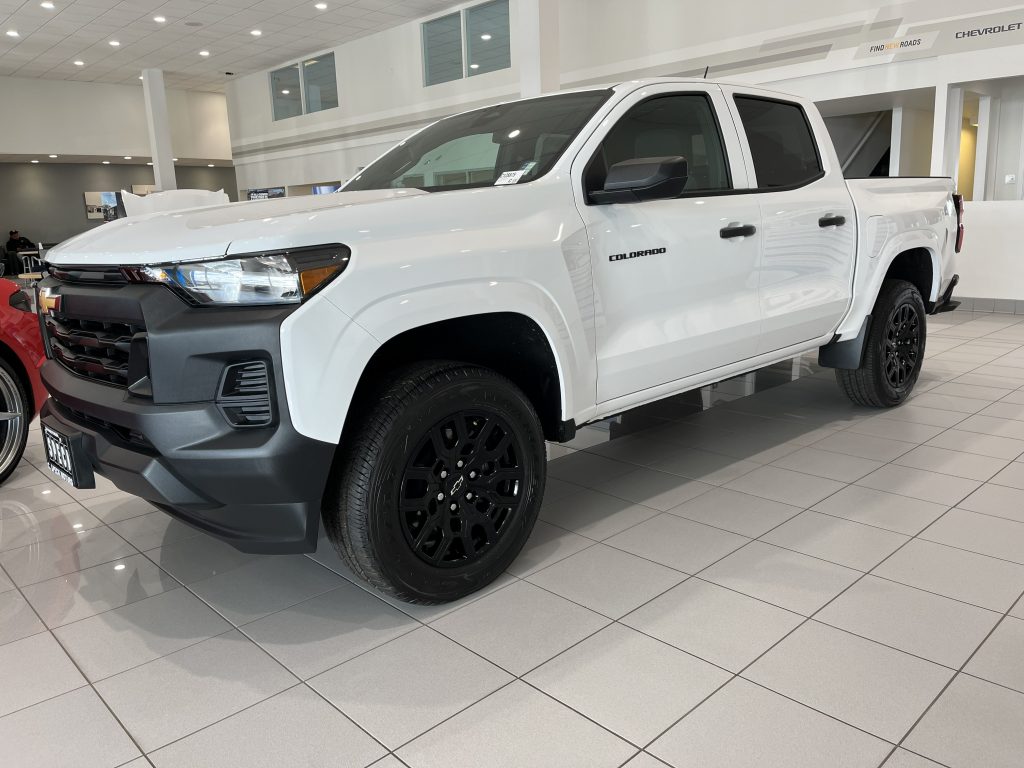
Chevrolet Colorado
Midsize Pickup · Great for everyday use & light hauling
The Colorado is one of the most popular used trucks we see come through our lot — and for good reason. It’s easier to park than a full-size, more fuel-efficient, and still capable of towing up to 7,700 lbs when properly equipped. If you want a truck for around-town driving, weekend camping runs, or lighter hauling without the bulk of a full-size, the Colorado is a smart choice. Available in a range of trims from work-ready base models to well-equipped ZR2 off-road variants.
Chevrolet Silverado 1500
Full-Size Half-Ton · The everyday workhorse
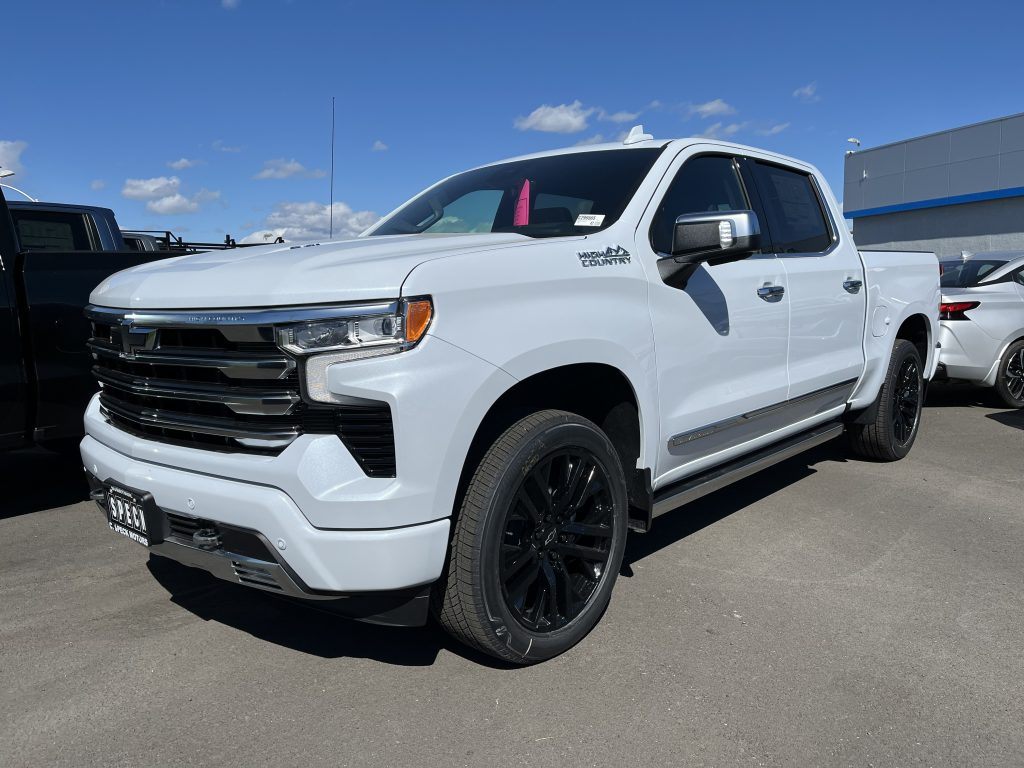
The Silverado 1500 is one of the best-selling trucks in America, and used examples are always in demand. As a used Chevy truck, the Silverado 1500 hits the sweet spot of capability and daily drivability — towing up to 13,300 lbs when equipped with the right engine and package, with a comfortable ride and available crew cab interiors that make long drives genuinely enjoyable. Whether you’re heading to a job site, pulling a boat to the Columbia River, or running the family around town, the Silverado 1500 does it all.
Chevrolet Silverado 2500 HD
Full-Size Heavy-Duty · Built for big jobs
When the job demands more, the Silverado 2500 HD delivers. With available gas and diesel engine options and the ability to tow upwards of 18,500 lbs when properly equipped, this is the truck for contractors, farmers, and drivers who take on serious loads on a regular basis. A used Silverado 2500 is a particularly great value — you get heavy-duty capability at a fraction of the new truck price, and these trucks are built to last well into high mileage. Available in regular, double, and crew cab configurations with 6’9″ and 8′ bed options.
The Sunnyside Tax Advantage
Here’s something most Tri-Cities truck shoppers don’t think about: where you buy your vehicle affects how much sales tax you pay. In Washington state, vehicle sales tax is based on the buyer’s location — but when you purchase at a dealership, the rate that applies is tied to the dealership’s location. That means buying your used Chevrolet pickup near Sunnyside, Washington could put real money back in your pocket compared to buying in the Tri-Cities.
| Location | Sales Tax Rate | Tax on $35,000 Truck |
|---|---|---|
| Sunnyside, WA | 8.2% | $2,870 |
| Kennewick, WA | 8.8% | $3,080 |
| Richland, WA | 8.8% | $3,080 |
| Pasco, WA | 8.9% | $3,115 |
*Tax rates are approximate and may vary. Always verify current rates with the Washington Department of Revenue. Tax example based on a $35,000 purchase price before incentives.
On a $35,000 used truck, buying in Sunnyside could save you $200–$245 in sales tax compared to purchasing in Kennewick, Richland, or Pasco. That’s money that stays in your pocket — on top of whatever deal we work out on the truck itself.
Ready to find your next used Chevy truck near Sunnyside, WA? Browse our current used truck inventory online or stop by C Speck Motors. Our lot turns over regularly, so new used Chevrolet pickups are always arriving. We’ll help you find the right truck at the right price — and keep more money in your wallet from the start.
The information provided is for general informational purposes only and does not constitute legal, financial, or professional advice. While we strive to provide accurate and up-to-date information, we make no guarantees regarding the completeness, accuracy, or reliability of the information presented. Any action you take based on the context of this blog is strictly at your own risk. Always consult a qualified professional or specialist for advice specific to your situation. We are not responsible for any losses or damages arising from the use of this blog or its content.
How Many Seats Are in the 2026 Chevrolet Suburban?
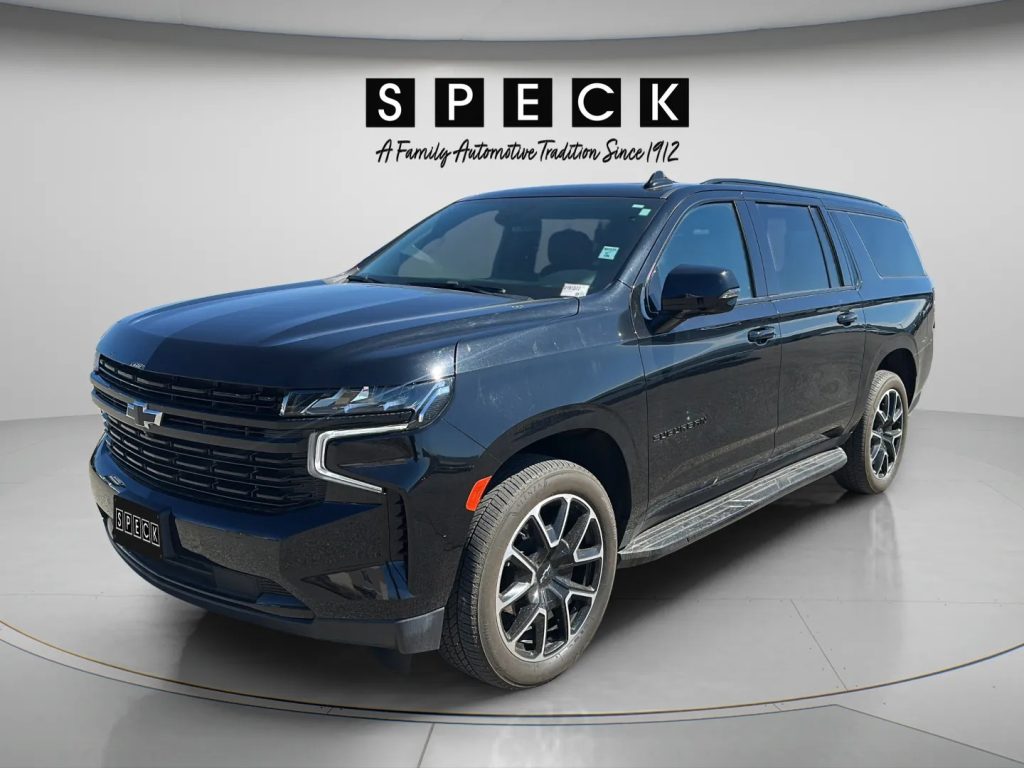
When it comes to hauling the whole crew, few vehicles can match the 2026 Chevrolet Suburban. It’s one of the largest and most capable full-size SUVs on the market, and its seating flexibility is a big part of why families keep coming back to it.
Seven, Eight, or Nine – It Depends on the Configuration
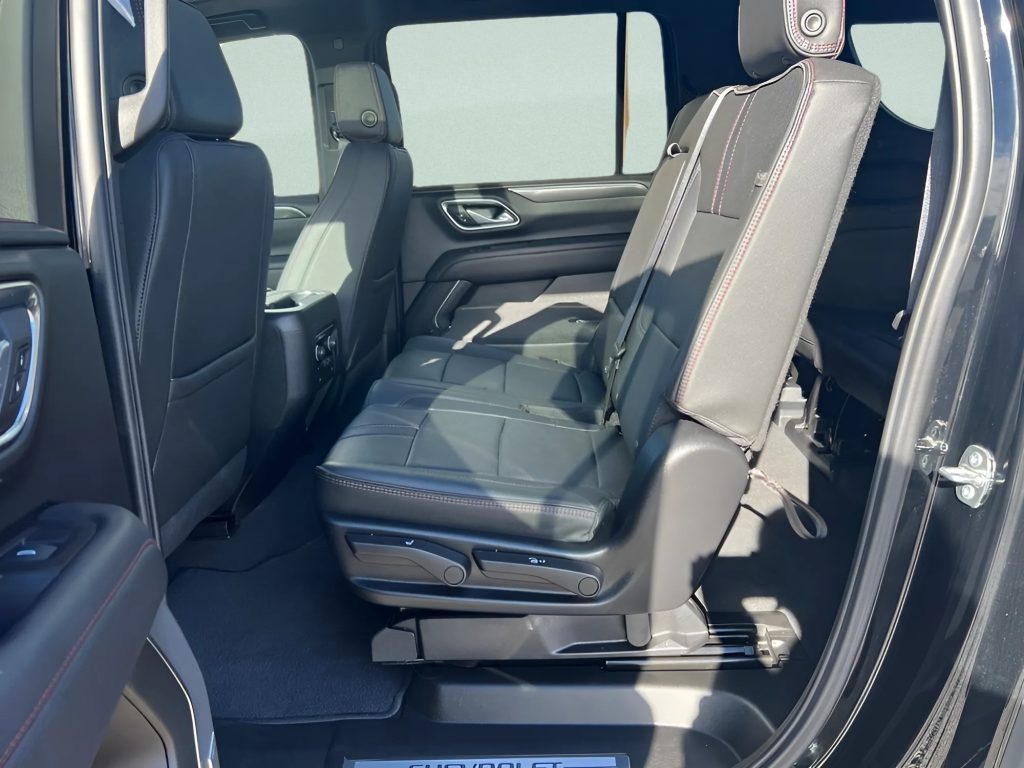
The 2026 Suburban doesn’t have just one seating number. Depending on the trim and options you choose, it can seat seven, eight, or nine passengers across three rows. Most trims come standard with eight-passenger seating, featuring front bucket seats, a second-row bench, and a three-person third row. If you opt for second-row captain’s chairs, that drops to seven seats but adds a convenient center aisle for easier third-row access. The base LS trim takes it even further. It can be configured with a front bench seat to unlock a rare nine-passenger layout, making it one of the few SUVs on the market that can seat that many people.
Third-Row Space That Actually Works
One of the biggest complaints about three-row SUVs is that the third row is too cramped for adults. The Suburban addresses this head-on. Its extended length gives the third row genuine headroom and legroom, making it a comfortable spot for teens and adults alike, not just a last resort. The second row also slides forward and back, letting you balance legroom between rows based on who needs more space.
Cargo Space When You Need It
Seating flexibility is only part of the story. With all seats up, the Suburban offers 41.5 cubic feet of cargo space behind the third row. Fold the third row and that jumps to 93.8 cubic feet. Fold both the second and third rows flat and you’re looking at up to 144.7 cubic feet of total cargo volume. It truly works as both a people mover and a hauler.
Final Thoughts
Whether you need seven seats for a growing family or nine seats for a carpool crew, the 2026 Chevrolet Suburban has a configuration that fits your life. Stop by C. Speck Motors of Sunnyside today to explore our current Suburban inventory and find the setup that works best for you. Be sure to check if we have any available specials!
The information provided is for general informational purposes only and does not constitute legal, financial, or professional advice. While we strive to provide accurate and up-to-date information, we make no guarantees regarding the completeness, accuracy, or reliability of the information presented. Any action you take based on the context of this blog is strictly at your own risk. Always consult a qualified professional or specialist for advice specific to your situation. We are not responsible for any losses or damages arising from the use of this blog or its content.
Transmission Fluid and Maintenance Guide
Why Transmission Fluid Maintenance Matters
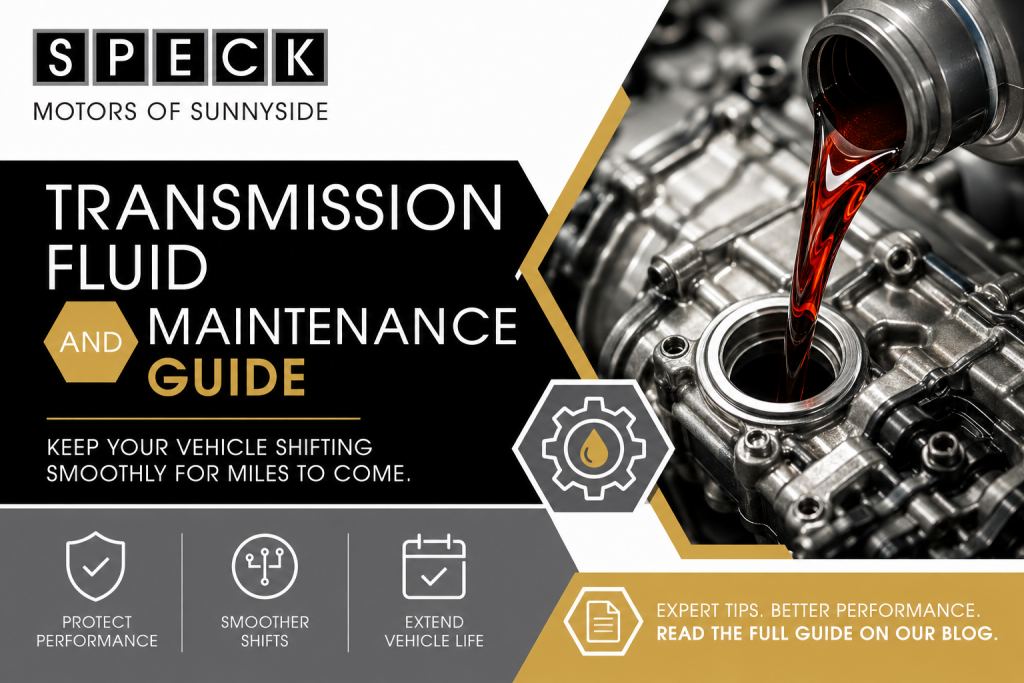
Your transmission fluid plays a vital role in keeping your vehicle running smoothly. It lubricates moving parts, regulates temperature and ensures smooth gear shifts. Without clean fluid, your transmission can overheat and wear down much faster than it should.
When Should You Change Your Transmission Fluid?
Most manufacturers recommend changing your transmission fluid every 30,000 to 60,000 miles, however always check your owner’s manual for the exact interval. Over time transmission fluid can break down and lose its ability to properly protect your transmission — staying on top of changes can save you from costly repairs!
Let Our Service Team Help!
If you notice hesitation during gear shifts, unusual noises or your transmission warning light comes on — it may be time for a fluid change. Stop in and let our experienced service team inspect your transmission fluid and keep your vehicle running at its best!
The information provided is for general informational purposes only and does not constitute legal, financial, or professional advice. While we strive to provide accurate and up-to-date information, we make no guarantees regarding the completeness, accuracy, or reliability of the information presented. Any action you take based on the context of this blog is strictly at your own risk. Always consult a qualified professional or specialist for advice specific to your situation. We are not responsible for any losses or damages arising from the use of this blog or its content.
Connect with us

